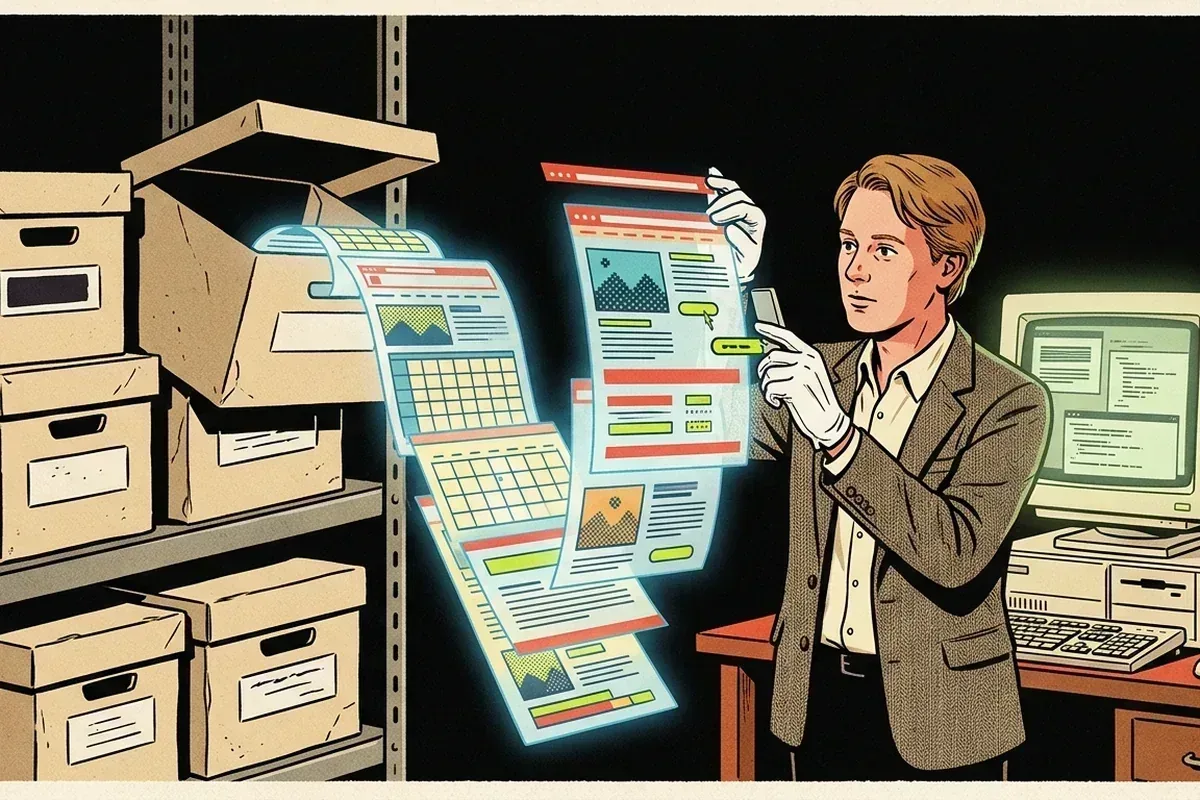
A reproducible Wayback research sequence
Every historical route and media file has its own capture history.
A successful HTML capture can still replay with missing images, styles, or scripts.
Cite the exact capture and limit the claim to what that artifact actually shows.
Search the exact object first
Start with the full historical URL rather than only the domain. The homepage, receiver.html, giver.html, and direct image paths can have separate capture histories. Replace the timestamp in a Wayback URL with an asterisk to view the calendar for that specific object.
Keep the original scheme and hostname in your notes. http and https versions, www and apex hosts, capitalization, query strings, and trailing slashes can lead to different archived records even when a modern browser would treat them as closely related.
Read the timestamp and status
The long number in a replay URL records the crawl time in YYYYMMDDhhmmss form. Internet Archive's calendar colors also reflect the HTTP status observed: a successful response, redirect, client error, or server error. A calendar dot therefore records a request outcome, not necessarily a complete page.
If a capture redirects, follow the chain while retaining the first URL and time. The destination may have been captured at another moment, so the replay can combine records rather than reproduce one synchronized browsing session.
Wayback capture and citation questions
Why is an image missing from an archived page?
The crawler may have captured the HTML but not that separate image request. Search the image's original URL independently before drawing a conclusion.
What do the numbers in a Wayback URL mean?
They encode the capture timestamp in year, month, day, hour, minute, and second order.
Does the oldest capture prove the page launched that day?
No. It proves that the archive collected the URL by then; an earlier live or unarchived version may have existed.
Diagnose missing images and styles
An HTML page can survive while its image, stylesheet, script, or Flash file is absent. Enter the missing asset's original URL into the archive separately. A broken replay is evidence of an incomplete capture, not automatic proof that the live page was broken at the time.
Archived pages may also reference a live resource when no capture exists, depending on replay behavior and browser settings. Avoid clicking unknown or explicit targets casually; collect URLs from the page source or controlled archive interface when the research question does not require rendering them.
Cite what the capture can prove
Record the page title, original URL, Wayback URL, capture timestamp, observed status, and the specific element supporting your claim. Use wording such as 'a January 2004 capture shows' instead of 'the site always contained.'
A capture cannot establish who authored a file, how many people saw it, or whether an earlier unarchived version existed. Combine it with registry records, contemporary reporting, and documented statements when those questions matter.
Sources and further reading
- Internet Archive Wayback Machine user guide
- Internet Archive Save Page Now guide
- Library of Congress web-archive limitations
Sources are provided for verification. External destinations may contain material GOAT.CX does not host or control. Review the source and corrections policy and the maintained GOAT evidence ledger.
Publication record
First published . Last substantive review . The updated date changes only after a source, factual, or explanatory revision - Not an automated timestamp refresh.