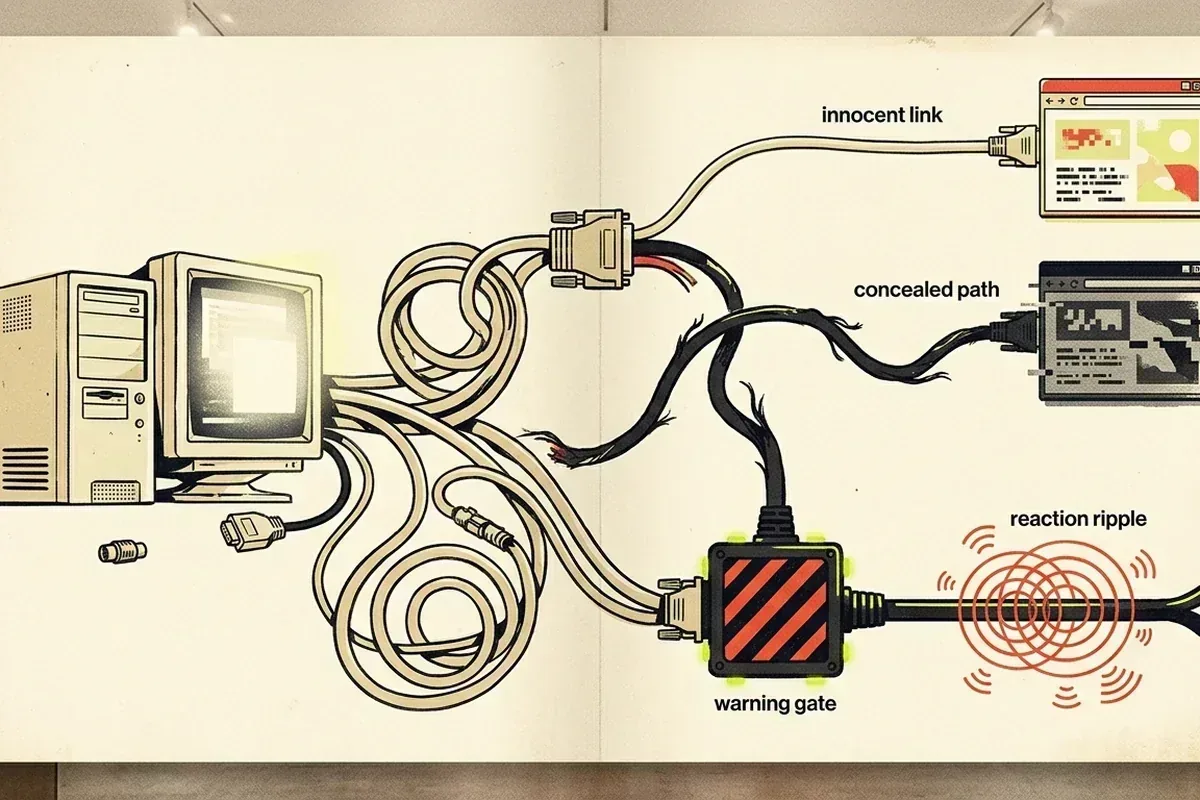
The four parts of the trick
First came a plausible invitation: a filename, label, or surrounding message that suggested an ordinary destination. Second came concealment, such as anchor text that differed from its URL, a shortened address, or an image loaded from another server. Third was the unexpected page. Fourth was the reaction reported back to the group.
The last stage made the prank repeatable. A recipient became a future sender after learning the destination, and community recognition gave the URL meaning before algorithmic recommendation systems existed. The link functioned as both delivery mechanism and membership test.
The four-part anatomy of a shock link
A shock link combined a misleading invitation, concealed destination, unexpected page, and social reaction.
Inline remote images sometimes removed the need for a recipient to click anything.
Descriptive links and advance warnings preserve user choice without erasing history.
Why early browsers and forums amplified it
Forums commonly allowed users to place remote images inside posts. Browsers fetched those resources automatically, so a viewer did not always need to click. Flat-file sites also exposed predictable media URLs that could be embedded or linked directly without the explanatory page around them.
Moderation tools were uneven, link previews were uncommon, and many people shared computers in homes, schools, or workplaces. The surprise therefore involved not only content but context: material could appear on a screen where the viewer had little privacy or ability to prepare.
The modern descendants
Phishing replaces shock with credential theft; drive-by download pages replace reaction with compromise; misleading redirects send visitors through advertising or tracking chains. The motive changes, but the user-interface problem remains a mismatch between the apparent and actual destination.
Modern browsers add reputation warnings, safer defaults, permission prompts, and clearer address bars. Messaging services may expand destinations or scan known malicious links. None of those layers removes the need to inspect a hostname and treat unsolicited urgency as a risk signal.
How publishers can remove the surprise
Use descriptive anchor text, identify external destinations, avoid forced new windows, and provide a plain warning before material that a reasonable reader may not expect. A warning should describe the category without repeating graphic detail and should appear before any automatic media request.
Historic preservation does not require recreating the original delivery method. A contextual HTML page can preserve a cited route, explain what it once did, and direct researchers to controlled archives without loading the withheld asset.
Shock-link mechanics and prevention questions
Did a shock link always require a click?
No. Forum software and webpages could load a remotely hosted image automatically, while other versions relied on disguised anchor text or redirects.
Are shock links the same as phishing?
No. Their typical purpose was surprise or humiliation, while phishing seeks secrets or costly action. Both can rely on a misleading destination.
How can a site preserve a historic shock URL safely?
Return a labeled HTML explanation at the route, with no automatic request for the original media and a clear path to contextual research.
Sources and further reading
- W3C guidance on meaningful link purpose
- Google Safe Browsing and dangerous-site labels
- Contemporary account of shock-link circulation
Sources are provided for verification. External destinations may contain material GOAT.CX does not host or control. Review the source and corrections policy and the maintained GOAT evidence ledger.
Publication record
First published . Last substantive review . The updated date changes only after a source, factual, or explanatory revision - Not an automated timestamp refresh.