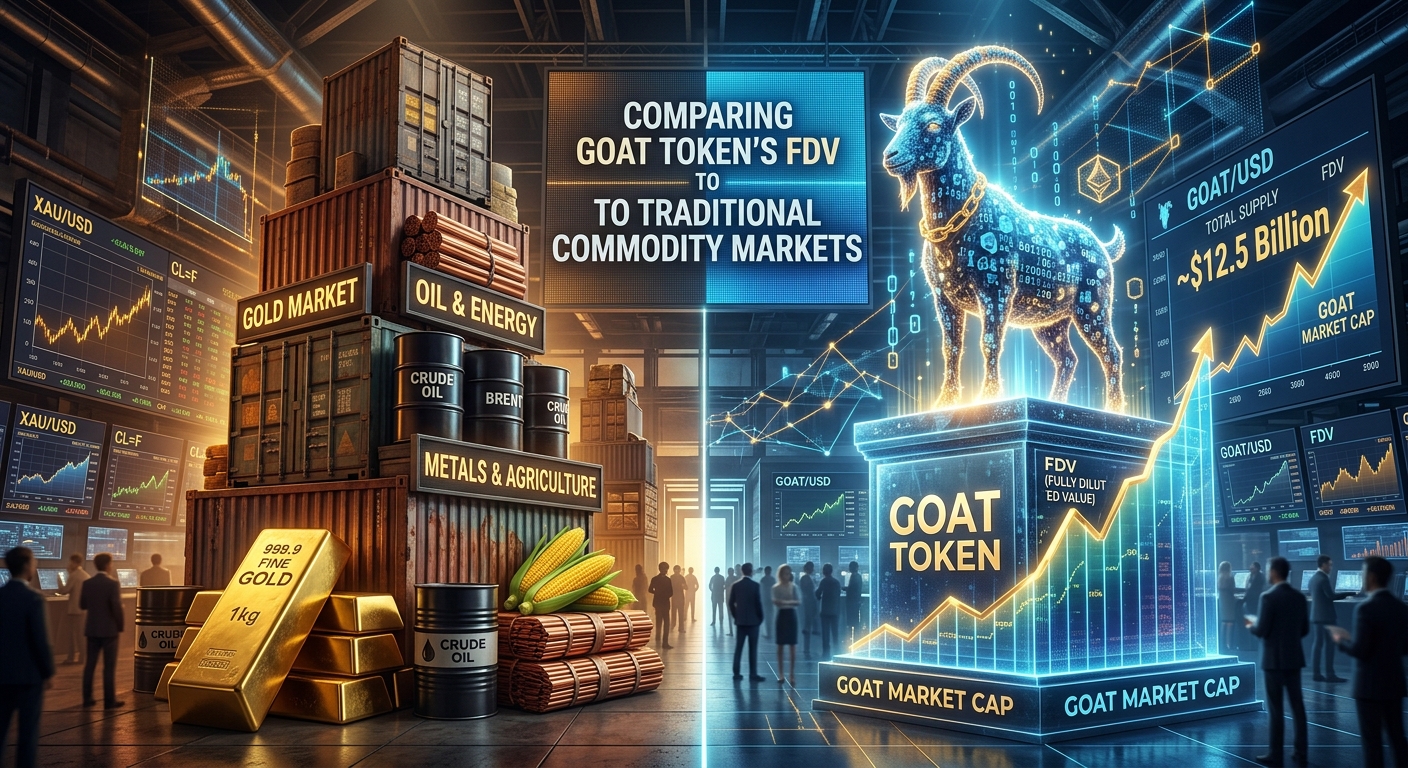
Scale Check: Key Points
- GOAT's total supply is exactly 1,000,000,000 tokens, verifiable directly on Solana's block explorer at any time.
- Fully diluted valuation equals total supply multiplied by price per token. At $1.00 per token, GOAT's FDV reaches $1 billion.
- Silver's global market value sits in the low trillions, making it a useful mid-tier benchmark for gauging GOAT's relative scale.
- Even near its approximate all-time high, GOAT's FDV represented a fraction of one percent of the silver market's total worth.
- This comparison is a calibration tool, not a price signal. Verifiable on-chain supply data is the foundation of every calculation here.
Why Fully Diluted Valuation Is the Number That Matters
Most retail traders focus on market cap. It is a familiar number, and it shapes how an asset feels in the moment. But for a fixed-supply token like GOAT, the fully diluted valuation gives you the more complete picture. FDV is simple math: multiply the total token supply by the current price per token. The result is the implied worth of the entire project if every token traded at today's rate. When total supply and circulating supply sit close together, FDV and market cap converge. For GOAT, that convergence is almost complete. That makes FDV the most honest figure to examine.
Circulating supply can be obscured through vesting schedules, team allocations, or wallets that have never moved. Total supply is harder to hide. It exists on-chain. Solana's block explorer timestamps every token minting event, and that record does not change without an on-chain action leaving a permanent trace. Anchoring this analysis to total supply rather than an off-chain reported figure is a deliberate choice about what can actually be verified. The answer to most crypto research questions should start exactly there.
GOAT's On-Chain Supply: What Solana's Explorer Actually Shows
Goatseus Maximus launched on Solana via pump.fun in late 2024. The token contract address is CzLSujWBLFsSjncfkh59rUFqvafWcY5tzedWJSuypump. Enter that address into Solscan or the native Solana explorer and you will find a total supply of 1,000,000,000 tokens. One billion. No time-locked team allocation sits behind that number. No undisclosed vesting schedule inflates it. The supply is what it is, and verifying it yourself takes under two minutes.
Pump.fun's bonding curve mechanics mean a portion of a token's early supply lives inside a liquidity contract until the token graduates to a decentralized exchange. Once GOAT graduated, that pool supply entered general circulation, and the on-chain record reflects the full transition. The mint page shows the supply figure directly. The top holders list shows concentration. Reading both together gives a more accurate picture of actual float than any third-party aggregator. If you are doing this research seriously, go to the explorer first. Treat everything else as a secondary starting point.
FDV at Historical Price Points: Running the Numbers
At five cents per token, GOAT's fully diluted valuation is $50 million. That figure already places the token in the upper tier of memecoins by scale. A $50 million FDV is not a rounding error. It represents real capital committed by real market participants, and it deserves to be treated seriously rather than dismissed because the nominal price per token looks small.
At ten cents the FDV doubles to $100 million. At fifty cents, the calculation produces $500 million. Cross the one-dollar mark and the fully diluted valuation reaches a clean $1 billion. GOAT approached and, at certain points during its most active trading window in late 2024, briefly exceeded that threshold. The AI-agent narrative attached to the Truth Terminal drove substantial inbound interest, and the FDV reflected that momentum in real time. Prices near $1.50 push the FDV to approximately $1.5 billion.
None of those numbers are forecasts. They are multiplication applied to a fixed supply figure that you can read from a public ledger right now. Working through several price points rather than only today's price is useful because it builds a mental model that stays functional whether the market moves sharply up or sharply down. A $500 million FDV and a $1.5 billion FDV are both conceivable outcomes for a token with broad narrative support and Solana's liquidity infrastructure behind it. Knowing what each implies before either happens removes at least one variable from your decision process.
Where Silver Fits as a Commodity Benchmark
Silver works as a mid-tier reference because it sits in a genuinely interesting position within traditional commodity markets. It is not the undisputed hierarchy leader that gold occupies. It is not a niche industrial input like rhodium or palladium. Silver has functioned as money across multiple civilizations, it remains a significant industrial input in solar panels and consumer electronics, and its market is liquid enough to reflect genuine global price discovery. Those characteristics make it a credible scale reference when placing a speculative asset in context.
Calculating silver's total market value requires a spot price per troy ounce multiplied by estimated above-ground holdings. Industry tracking bodies, including the Silver Institute, monitor global supply figures closely. Estimates for total above-ground silver stocks typically land somewhere between 1.5 million and 1.8 million metric tons when investment bars, coins, jewelry, and industrial fabrication are all counted. One metric ton equals approximately 32,150 troy ounces. At most recent spot prices, even the conservative end of that range produces a total market value in the low trillions of dollars. Because that number shifts daily with the spot rate, anyone tracking this comparison should pull a current reading from a live silver price chart rather than trusting a static figure printed in any article, including this one.
With silver's market cap sitting somewhere in the $1.4 to $1.7 trillion range depending on the day, GOAT's approximate peak FDV of $1.5 billion represented something in the neighborhood of 0.1 percent of the silver market's total worth. That fraction is tiny. But the point of the comparison is not to argue that GOAT is insignificant or that silver is unreachable. The point is to provide a reference frame that prevents both over-excitement and false equivalence from distorting your read of the numbers.
Commodity Markets Dwarf Individual Tokens by Design
Gold's total above-ground market value is typically estimated between $14 trillion and $18 trillion at current prices. Silver follows in the low trillions. Copper, despite its much lower per-unit price, has an enormous global stockpile that pushes its total market value into multi-trillion territory depending on estimation methodology. These are markets shaped by centuries of institutional participation, central bank reserves, sovereign wealth allocation, and physical industrial demand that runs through the backbone of global manufacturing. Their valuations reflect long-term structural fundamentals that do not shift on news cycles.
GOAT operates in a fundamentally different category. Its market cap reflects narrative momentum, trading volume on Solana, and the dynamics of AI-agent speculation during a particular moment in crypto history. Those inputs are real. They drove real price action and real capital flows. But they are categorically different from the forces that price silver. Placing GOAT's FDV next to silver's market cap is not an attempt to conflate those categories. It is an attempt to anchor the former to a real-world scale that most people can intuitively grasp without requiring a background in institutional finance.
The ceiling question is worth considering clearly. For GOAT's FDV to match a $1.5 trillion silver market, the token price would need to reach $1,500 per token. That is arithmetic, not prediction. Whether such a price is possible depends on factors far beyond supply mechanics, including global liquidity conditions, regulatory frameworks, and the long-term staying power of the AI-agent narrative that carried GOAT into broader awareness. Knowing the arithmetic of the gap between current FDV and commodity-market equivalence is simply a useful input to any serious analysis.
On-Chain Verification as the Foundation
Verification should precede opinion in this market. GOAT's total supply is public and fixed. The FDV calculations in this piece follow directly from that supply figure using straightforward multiplication. The commodity benchmarks draw on publicly available pricing data and widely cited industry estimates from recognized silver market tracking bodies. Each step in the comparison chain is independently checkable by anyone with internet access and ten minutes to spare.
For readers new to Solana token verification, the process is direct. Open Solscan, enter the contract address, and read the supply field on the token overview page. Then examine the top holders distribution. A top-heavy distribution can create its own class of market risk even when nominal supply is fixed and transparent. Concentration at the top of the holder list means that a small number of wallets can move price significantly. That information lives on-chain and updates as tokens transfer between holders, which means your read of concentration today may differ from the picture a month from now.
For the commodity side, the key input is silver's current spot price. That figure shifts with global macro conditions, industrial demand cycles, and investor sentiment around inflation and currency risk. A static price embedded in a published article becomes outdated within days. Building the habit of pulling a live figure keeps your own calculations current and prevents you from treating someone else's snapshot as a permanent fact.
What the Numbers Actually Tell a Risk-Aware Reader
GOAT reached a fully diluted valuation, at its peak, comparable to a mid-sized publicly traded company. It never threatened the silver market. It was never positioned to. The comparison is useful not as evidence of undervaluation or overvaluation but as a proportional frame of reference that abstract dollar figures cannot supply on their own.
Risk-aware investors benefit from holding both figures in mind at the same time. The token's FDV reflects current market sentiment and the growth expectations baked into today's price. The commodity benchmark reflects the scale of markets that have operated across decades of economic cycles and multiple monetary regimes. The gap between the two is not a reason to buy or sell in either direction. It is a fact about scale, and facts about scale are worth knowing before committing capital.
Verification-first research does not produce certainty. It produces better-calibrated uncertainty, which is a meaningful improvement. GOAT's on-chain supply is fixed and readable by anyone. The FDV at any given price is arithmetic with no hidden variables. The commodity market context is drawn from publicly available data that has been tracked and published by industry bodies for decades. Everything beyond those inputs is interpretation, and honest analysis should label it clearly as such. Start with what you can verify. Build your framework outward from there. That discipline does not guarantee better outcomes, but it guarantees a cleaner starting point than accepting someone else's conclusions on faith.