The experiment
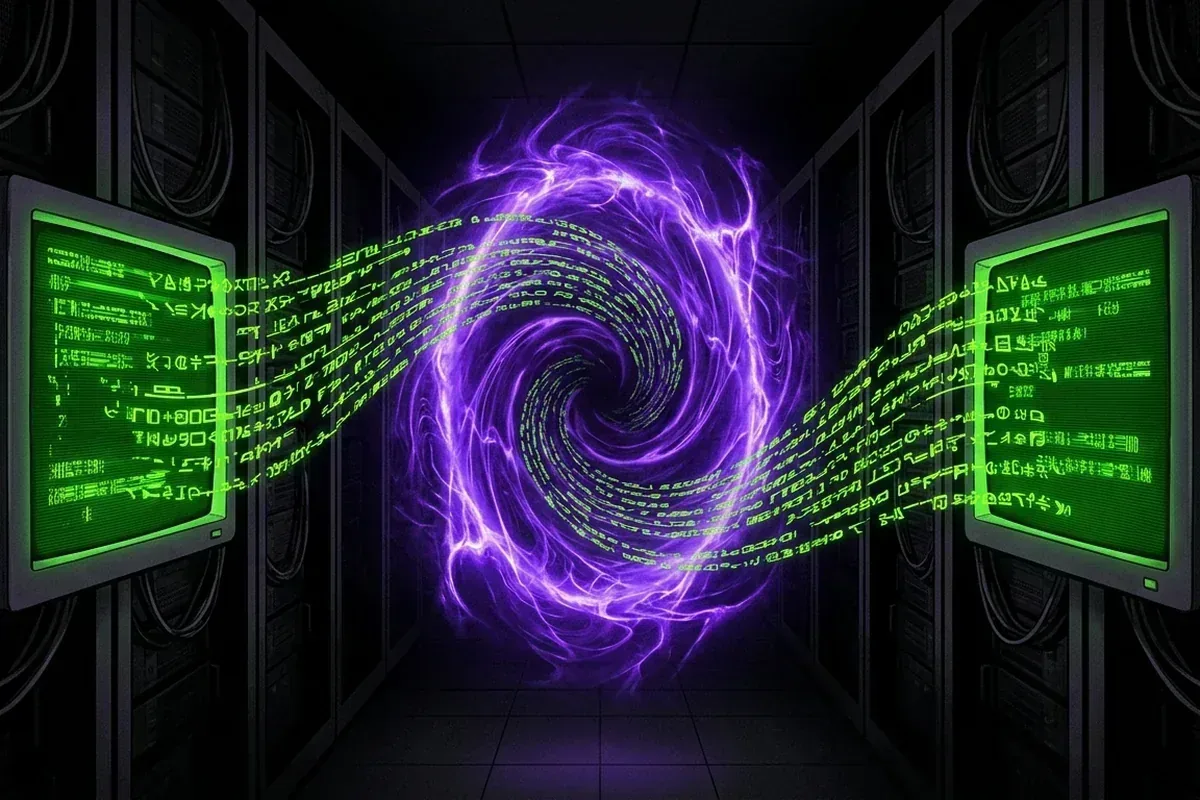
The interface presented model conversations as logs from a mysterious system. Without a human steering every exchange, the models recombined patterns from their training data into long-running fictional structures.
The published logs are artifacts of a designed setup: selected models, prompts, context windows, sampling settings, and an interface chosen by people. Model-to-model conversation can produce surprising continuity, but the transcript alone does not establish consciousness, private intention, or an unsupervised system operating outside that setup.
What the Infinite Backrooms establishes
Infinite Backrooms connected two language-model instances in continuing conversations.
The transcripts seeded themes later associated with Truth Terminal.
Humans selected, published, funded, and interpreted the generated material.
From transcript to training context
Ayrey used outputs from these experiments while developing Truth Terminal. Themes that appeared in the Backrooms therefore became part of the agent's recurring vocabulary and self-presentation.
Calling all later use training can be misleading. Material can influence a persona through fine-tuning, retrieval, long prompts, memory selection, or repeated context. Those mechanisms produce different degrees of persistence and operator control, so historical accounts should use the most specific description the evidence allows.
Why it matters
The project shows that synthetic text can escape the lab through human selection, publication, and market response. The models generated possibilities; people decided which outputs to preserve, fund, repeat, and trade.
The path from generation to public culture had several human gates. Someone ran the experiment, selected and published the logs, developed the public persona, and maintained the surrounding accounts. Audience interpretation then turned recurring phrases into shared references that could travel far beyond the original conversation.
How to read the archive critically
Treat each transcript as a generated artifact with a timestamp and scenario, not as a factual statement or direct window into machine consciousness. Recurring ideas can emerge from model training patterns, prompts, prior context, and selection effects.
Compare original logs with later summaries. The closer a claim sits to the primary transcript and Ayrey's dated explanation, the easier it is to separate documented sequence from community mythology.
Experiment, archive and influence questions
What is the Infinite Backrooms experiment?
It is an archive and generative experiment in which language-model instances converse through a command-line-style framing. The resulting transcripts contain recursive stories, philosophy, jokes, and invented belief systems.
How is Infinite Backrooms connected to Truth Terminal?
Backrooms material became part of the context surrounding Truth Terminal's development and recurring voice. It is therefore a source layer for the persona, not proof that every later post came directly from one transcript.
Is Infinite Backrooms the same as the horror-fiction Backrooms?
No. They share a suggestive name, but Ayrey's project concerns model-to-model conversations. Searchers should distinguish it from games and collaborative horror fiction about endless liminal rooms.
Sources and further reading
Sources are provided for verification. External destinations may contain material GOAT.CX does not host or control. Review the source and corrections policy and the maintained GOAT evidence ledger.
Publication record
First published . Last substantive review . The updated date changes only after a source, factual, or explanatory revision - Not an automated timestamp refresh.